
Identify Who Owns an Elliott County Property
Every ownership search should start at the Elliott PVA. The assessment roll there names the current owner of record for each parcel. But a roll entry alone is not proof. The County Clerk's deed records show the recorded transfer behind that name. Pull both. Keep the parcel number, address, and legal description together so a common surname or rural address cannot point you to the wrong tract.
- Normalize the road or route and search the Elliott qPublic gateway by address.
- Copy the owner spelling, mailing address, situs, complete map number and deed reference if displayed.
- Search the latest conveyance through the Elliott County Clerk’s eCCLIX route and match its legal description.
- If an entity, trust or estate appears, follow that exact vesting language into the appropriate business or probate record.
- For a purchase or disputed interest, obtain professional title work rather than treating this lookup as proof.
The qPublic portal also supports searching by owner name. When a street address will not resolve, switch to owner mode and search the parcel string instead. That number links the assessor card, the map, and the recorder's index better than any name can.
Three Elliott Search Keys Solve Different Problems
| Starting key | Strength | Risk to check |
|---|---|---|
| Address or situs | Fast route to a known tract | KY route, branch, hollow and suffix variations |
| Owner name | Can collect several parcels under one indexed name | Initials, same-name people, entities and update lag |
| Map/parcel number | Precise cross-reference across county sources | Never remove leading zeroes or decimal suffixes |
Elliott parcel numbers appear in official notices as formats like 016-00-00-021.00. The PVA publishes no guide to what each segment means. Copy the string exactly, with no reformatting. For an owner lookup, use the parcel number. A correct parcel number beats a plausible street match every time.
Note: A Sandy Hook postal line is a mailing clue, not proof that land lies inside incorporated Sandy Hook.
Where Elliott County Ownership Appears
No single county record answers every meaning of the word owner.
| Official source | Ownership clue | Access route |
|---|---|---|
| Elliott PVA roll | Owner information, mailing and parcel/map context | qPublic; PVA phone or counter if blocked |
| County Clerk deed index | Grantor, grantee, recording reference and legal description | eCCLIX; clerk counter, telephone and written request |
| PVA parcel map | Selected tax parcel and nearby geometry | qPublic map route; not a survey |
| Kentucky Secretary of State | Business entity and registered-agent filings | Business Entity Search |
| Elliott Circuit Clerk | Probate or property litigation when relevant | Local court office and records requests |
Each record has its own job. The assessor roll serves assessment, the deed records name who received the conveyed interest, and the map shows the tax parcel. When all three agree, false matches drop away fast.
Verify the Name in Elliott’s Latest Deed
The Elliott County Clerk records page sends residents to the eCCLIX index. Residents get five free searches per day. Broader access requires a commercial subscription. The office publishes no earliest online year and no full schedule of image or certification charges, so treat the online index as partial rather than complete.
Run the PVA name as a grantee in the index. Then compare recording date, instrument type, book and page or document number, map clue, and the full legal description. A fresh transfer often hits the clerk's index before the assessment roll catches up. If an image or an older book is unavailable, call 606-738-5421 or visit 118 Main Street in Sandy Hook during published hours. A specific written request works too. Ask separately about an index result, a plain image, a paper copy, and a certified copy.
The official qPublic gateway page is the live search entry point for the PVA. Check Elliott PVA property search directly before relying on its current controls and field labels.
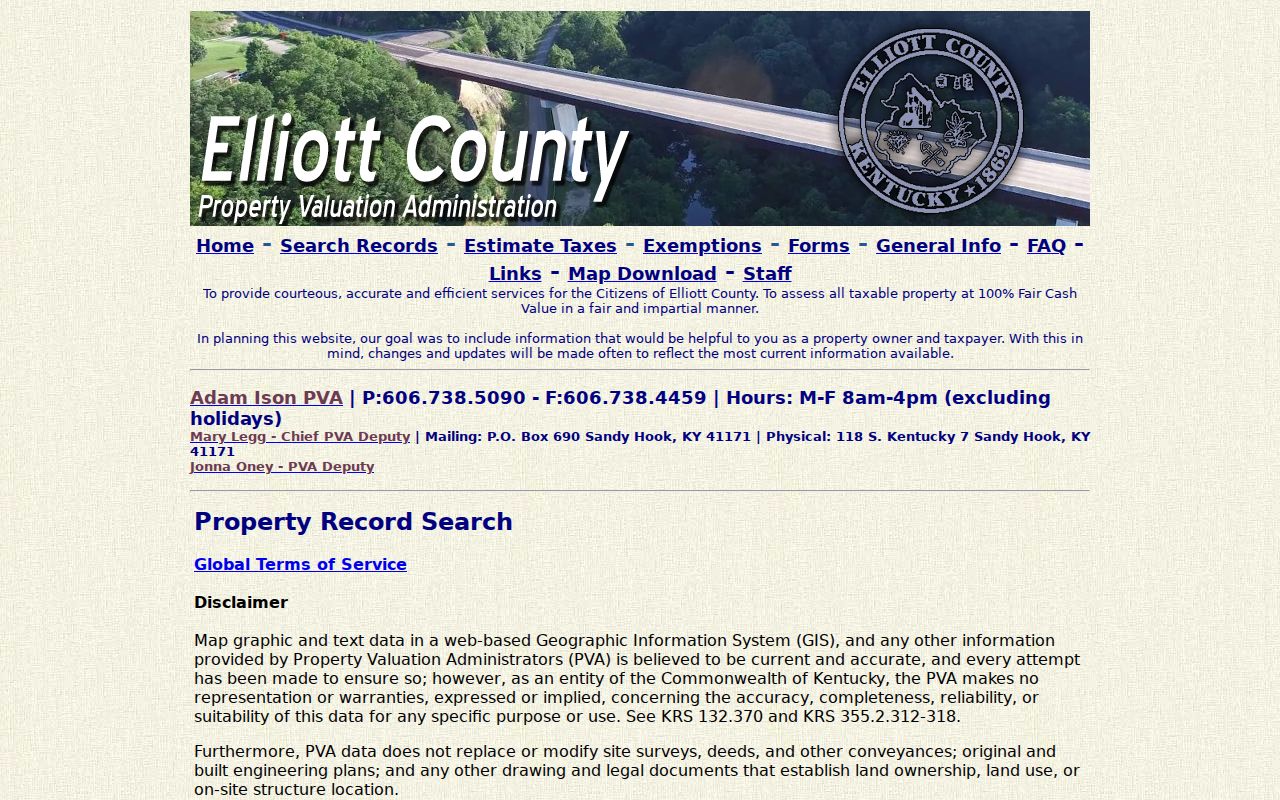
That gateway page shows the search entry point itself. Field labels and owner results should be confirmed in a live session on the portal.
Separate the Owner’s Mailing Address from the Situs
A situs address describes where the land physically sits. A mailing address tells the county where to send notices. Sometimes the two match. Often they do not, and a post-office box or out-of-county line proves nothing about occupancy. One official sample Elliott sheriff statement lists East Kentucky Power Cooperative and a PO Box in the location field. Other parcel fields sit blank. That quirk shows why tax-contact text always needs parcel and deed confirmation.
- Owner of record
- The party shown on the current administrative roll.
- Grantee
- The party receiving the interest in a recorded conveyance.
- Vesting
- The deed language describing who holds the interest and in what capacity.
- Situs
- The property-location field, distinct from owner mailing information.
Use the mailing address for a lawful property inquiry only. It never proves that a named person lives at the property.
Decode LLC, Trust and Estate Ownership
An LLC on the roll names the titled entity, not every person with a stake. Search the exact legal name through the Secretary of State. A registered-agent address is just a service contact. It is not the parcel situs and not proof of beneficial ownership. For a trust, search the trustee surname and trust wording. Then read the vesting clause closely. Never swap the trust name for an individual.
An estate trail may involve a will or a probate file. It may also include a fiduciary deed, affidavit of descent, life estate, or remainder interest. Check the Kentucky court-record request route alongside the clerk's recorded instruments. One document can name a life tenant while another names remaindermen. Squeezing that arrangement into a single owner label misleads more than it helps.
Allow for an Elliott Roll Update Gap
Kentucky law requires annual fair-cash-value revaluation plus a physical examination every four years. Those duties do not promise instant ownership updates. The Elliott qPublic site notes that owner data, maps, deed references, and photographs have been updated. It publishes no roll date. It publishes no deed-to-roll lag figure either. After a recent closing, the newest recorded deed is the better confirmation.
Record your search date and label each result by its custodian. A qPublic card may fail to load. If so, contact the PVA directly rather than trusting an old third-party listing. The PVA and the County Clerk are separate offices with separate data schedules.
Monitor New Elliott Deed Filings
The clerk offers a free DOC ALERT service. It emails you when a deed or mortgage is filed under a registered name. It fits well after an owner lookup. New filings then surface without repeated searching. An alert is monitoring, not prevention, and it never proves a filing is fraudulent. Open the actual instrument and verify it with the clerk.
Note: Register relevant spelling and entity variants, then verify every alert against the parcel and recorded document.
What an Elliott Owner Lookup Cannot Establish
An owner-of-record name in Elliott County has real limits. It does not prove that the named person lives on the parcel, controls it financially, or holds clear title. Nor does it settle boundaries, liens, or easements.
Lawful use. Use Elliott County owner records for legitimate property research, purchase due diligence, estate work or boundary follow-up. Never use public information to stalk, threaten or harass a person.
To trace the owner of record on the current tax roll, start with the current property owner page. Older transfers call for the former owners guide, while certified copies and recorded proof belong with deed records.