
Compare the Three Elliott County Value Signals
No single Elliott County parcel card gathers the assessed value, the market value, and the recorded sale price in one place. Label every number by its keeper and its effective date.
| Value type | Meaning | Authoritative trail |
|---|---|---|
| Assessed value | PVA valuation used in property-tax administration | Elliott PVA assessment record for the stated year |
| Taxable value | Assessment after an applicable exemption or treatment | PVA exemption and tax records |
| Sale or consideration amount | Amount associated with a recorded transfer; not automatically current market value | County Clerk deed or transfer instrument |
A private appraisal is one professional's opinion fixed to its own date. An asking price is just a seller's figure. A sale price records one completed transaction, and none of these should quietly stand in for the county assessment.
Read Kentucky's Fair-Cash-Value Standard Correctly
Kentucky law sets a single yardstick. The Kentucky Department of Revenue assessment guide explains that the PVA assesses real property at fair cash value. It is a tax rule, not a private appraisal. KRS 132.690 carries the schedule, requiring revaluation every year and a physical examination at least once every four years. The statute names no Elliott revaluation year. Read it as a cycle every county must meet, never as a calendar pinpointing when Elliott County property was last examined.
Look Up an Elliott County Assessed Value
The Elliott PVA qPublic gateway offers owner, address, and parcel search options. Fields on the results screen can vary, so follow this focused sequence:
- Search the address and confirm the parcel/map number and legal-description clues.
- Record the assessment year and every clearly labeled land, improvement, total, or taxable field that the live card actually shows.
- Note exemptions separately instead of treating taxable value as the full assessment.
- Open the newest relevant deed when a recorded sale amount is needed, and preserve that instrument's date.
- Assessed value
- The PVA's value for public assessment purposes.
- Fair cash value
- Kentucky's statutory assessment basis.
- Taxable value
- The amount remaining after applicable exemption treatment, where shown.
- Consideration
- A transfer amount stated in or associated with a deed; it needs context and a date.
- Reassessment
- A later valuation cycle or event that changes the official assessment.
Verify Elliott Land and Improvement Fields Live
The PVA maintains ownership records, maps, transfers, photographs, and measurements, so the material behind a parcel is rich. That inventory does not promise a land-versus-improvement split. Read the labels on the live record. The official Elliott property-search gateway shows the route into the assessment application.
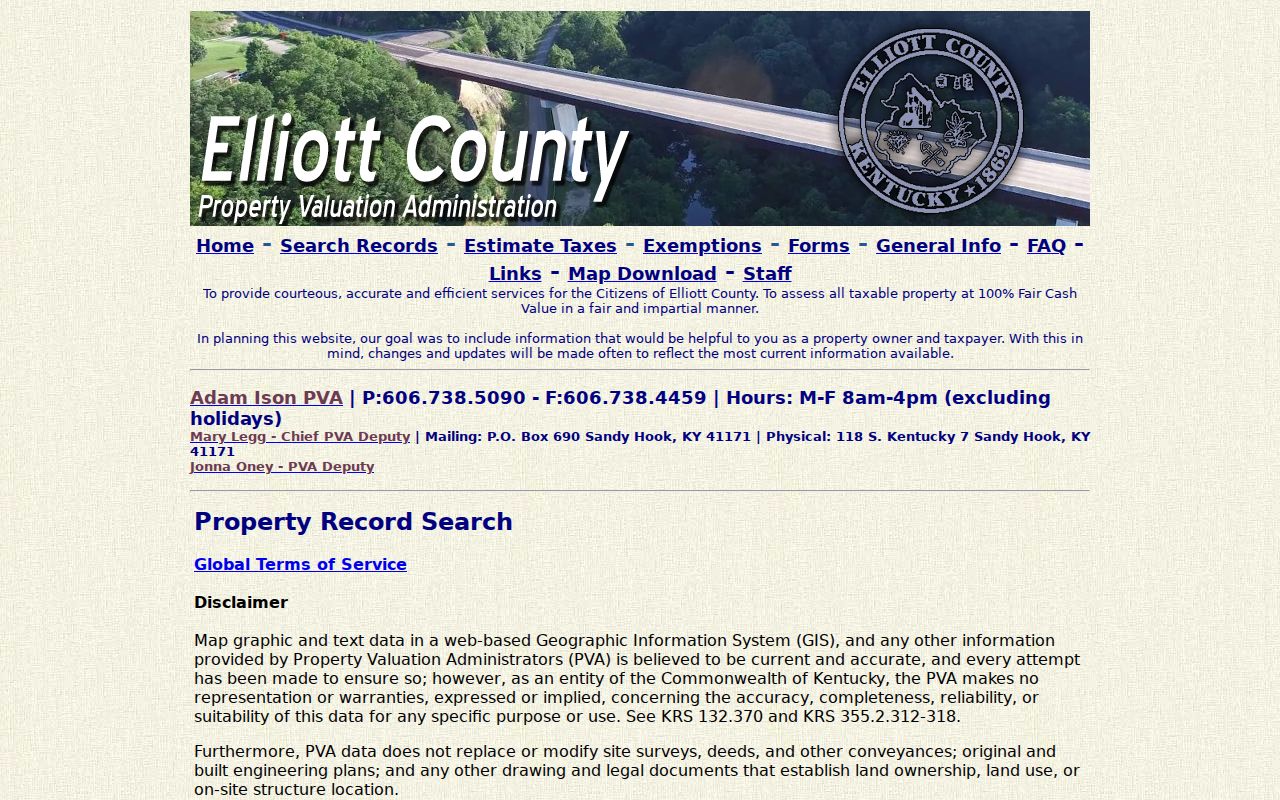
The gateway marks the official way in. Valuation labels and the assessment year still have to be confirmed on the live result itself.
Separate Elliott Assessed and Taxable Value
The Elliott PVA exemption page covers three routes: age, disability, and agricultural use. Its example subtracts a $40,500 homestead exemption from a $150,000 assessment. That leaves $109,500 taxable. The figures illustrate a method, not a universal exemption amount. Verify them against your own parcel.
Two similar assessments can still be taxed differently. How a bill is calculated, paid, pursued after delinquency, and appealed belongs on the property tax records page.
Find Elliott Sale Amounts in the Recorded Trail
Deeds are recorded by the County Clerk. The clerk's eCCLIX route opens a party-name search into those deed records. Match the legal description or map reference before treating a transfer as your parcel. Residents get five free searches a day. The published page states no online cutoff. It promises no complete image set.
A consideration figure belongs to its own transfer date and terms. Family transfers, quitclaims, fiduciary deeds, multi-parcel sales, and partial interests can make it a weak market comparison. Treat the amount as evidence of one recorded event. It is not a present-value estimate.
Note: Keep the deed reference and parcel identifier together so similar names or rural address variants do not create a false match.
Put Elliott's PVA Work Numbers in Context
The PVA's own numbers describe a busy office. Its site reports more than 3,000 photo updates, over 1,000 mapping corrections, and more than 2,000 farm-value reviews in the prior year. Roughly 60,000 searches were run as well. Those are workload measures, not a countywide price trend.
No Sandy Hook or Elliott County value-trend series is published. A defensible comparison needs dates, property characteristics, verified transfers, and the exact assessment field, none of which a county activity statistic can supply.
Use the Elliott PVA Counter When the Portal Fails
The counter still matters when the portal falls short. The PVA office at 117 Main Street, Sandy Hook, KY 41171, reached at (606) 738-5090, can explain assessment labels and available parcel material. One wrinkle involves leadership. The qPublic staff page lists Adam Ison as PVA since December 2022, while a county roster names another officeholder. Verify the current official rather than merging the two.
Certified deed copies are a separate errand. Contact the County Clerk at 118 Main Street, (606) 738-5421. For anything unpublished, Kentucky's Open Records Act generally calls for an agency response within five business days, excluding weekends and legal holidays, subject to exemptions and fee rules.
Understand What Elliott Property Value Cannot Prove
An assessment is an administrative number. It reveals no hidden defects. It fixes no boundaries, guarantees no condition, and predicts no sale price, and the PVA disclaimer adds that map data replaces no survey, deed, or engineering plan.
Value is not price. An Elliott County assessed value is not a sale guarantee or private appraisal; compare each number only within its documented source, year, and purpose.
Assessment-method questions go to the PVA. Recorded consideration belongs to the Clerk, while an independent opinion tied to a transaction date and a property's condition calls for a qualified appraiser.