
Read Elliott County Property Tax Records
Assessment, collection, and delinquency each belong to a different Elliott County office. The PVA sets the value and applies any exemptions. The sheriff collects current real-estate tax, and once a delinquent bill lands in the lien book, the County Clerk owns the record.
| Field | What It Shows | Where |
|---|---|---|
| Owner and map number | Assessment-roll identity and parcel cross-reference | Elliott PVA |
| Land, improvement and total | Components used in the assessment | Elliott PVA |
| Exemption | Qualifying reduction applied to taxable assessment | Elliott PVA |
| Bill, districts and charges | Taxing jurisdiction, amount and payment line | Elliott Sheriff for current tax |
| Delinquent lien and sale status | Past-due claim after transfer to the lien book | Elliott County Clerk |
Kentucky assesses real property at fair cash value. That number drives the tax roll. A bill blends the assessment with exemptions and district levies, so it is neither a recorded sale price nor a promise of resale value.
Route Elliott Tax Questions to the Right Counter
| Question | Office | Best route |
|---|---|---|
| Value, property description or exemption | Property Valuation Administrator | PVA office and qPublic |
| Current real-estate tax bill or payment | Elliott County Sheriff | Local tax contacts |
| Delinquent bill, lien book or sale | Elliott County Clerk | Delinquent-tax page |
This split causes plenty of wasted calls in Elliott County. The PVA cannot take the sheriff's current payment, and the sheriff cannot change an assessment, so bring each question to the office that actually owns it.
Search Elliott Assessments Three Ways
The qPublic gateway searches Elliott County assessments three ways. Enter an owner, an address, or a parcel number, and confirm field labels and displayed years live within the Schneidercorp application before relying on any single result.
| Owner | Useful when the bill or parcel address is unknown; check entities and initials. |
|---|---|
| Address | Useful for a known site; distinguish physical situs from owner mailing address. |
| Map number | Most reliable bridge among assessment, bill, deed and sale records. |
Rural addresses sometimes fail in the portal. Copy the complete map string instead. Pull it from a deed or an official notice, keeping every leading zero and decimal suffix, then take it to the PVA counter or a phone inquiry.
Look Up an Elliott County Tax Bill
The Elliott County sheriff publishes no online tax-payment portal. Identify the parcel first through the PVA record. Then call the sheriff for a current bill, or the County Clerk once a bill has gone delinquent.
- Find the assessment by owner, address or map number in qPublic.
- Confirm the tax year, owner, map number, district and assessment components.
- Ask the sheriff for the current bill and payment status.
- If delinquent, ask the County Clerk for the lien-book entry and current sale status.
- Fair cash value
- Kentucky's statutory assessment basis for real property.
- Levy or rate
- The rate applied by a taxing jurisdiction to the taxable assessment.
- Homestead exemption
- A qualifying reduction associated with an eligible personal residence.
- Tax lien
- The public claim arising from unpaid property tax.
January 1 Controls the Elliott Tax Name
January 1 sets the tax name in Elliott County. The PVA FAQ places the bill with the owner of record on that date. A buyer and seller can prorate tax in their contract. That private arrangement never moves the county's statutory assessment date. So a bill addressed to a previous owner can coexist with a later recorded deed. The FAQ also cautions that failure to receive a bill does not excuse payment.
Ownership that changed after January 1 shows up in the County Clerk's deed index. Each recorded deed names the new owner of record.
Note: Match the year before comparing owners or amounts on Elliott property tax records.
Elliott Homestead, Disability and Farm Exemptions
The PVA exemptions page lays out age and disability routes tied to a qualifying personal residence and ownership. Agricultural classification works differently. More than ten acres in actual agricultural or horticultural use qualify automatically. An exemption flag on a parcel can explain the gap between assessed and taxable value. It does not prove anyone currently lives there.
The PVA forms page carries the real-property conference form 62A023, the property-tax appeal form 62A350, and tangible-property schedules. Ask which form fits the current tax year. Documentation varies by route.
That official page is the county-specific eligibility starting point.
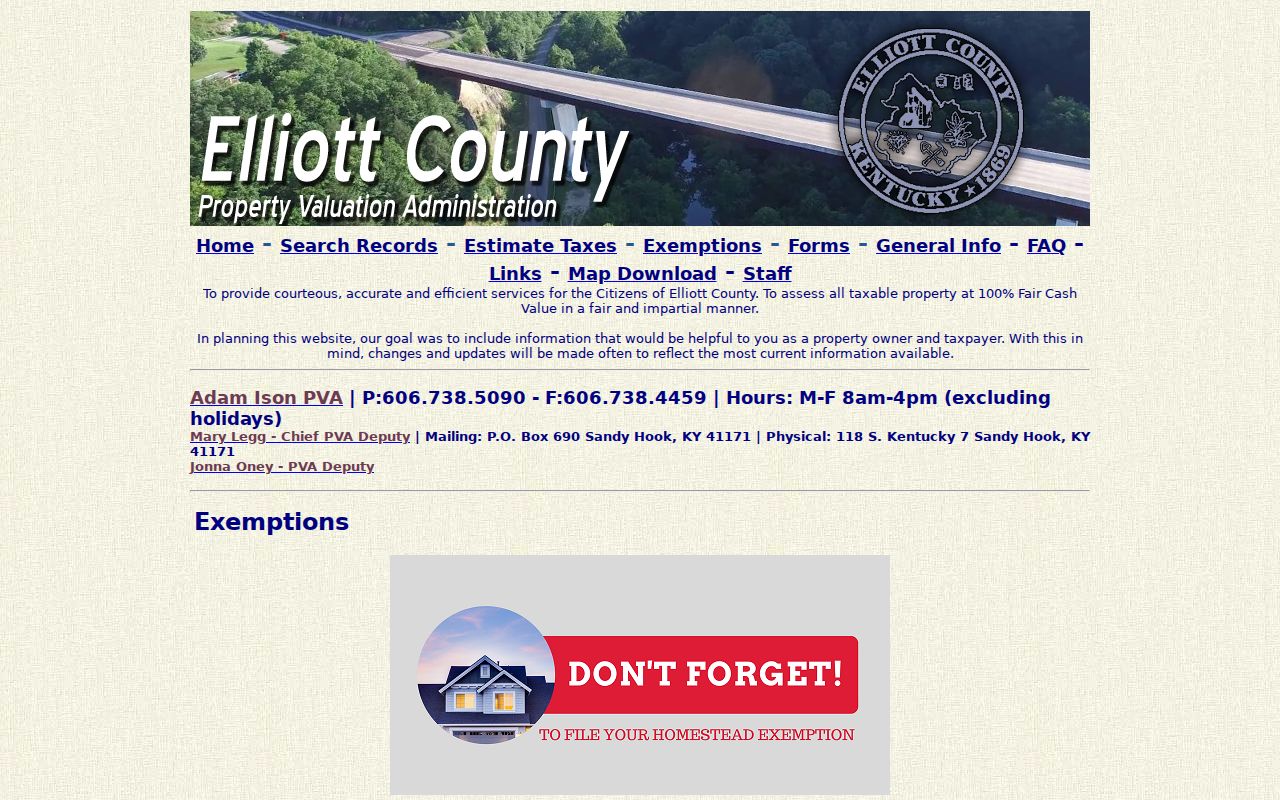
Treat the exemption page as a lead. Let the PVA confirm qualification and the assessment year in which the exemption actually applies.
Read a Sparse Elliott Tax Statement Carefully
One official sample sheriff statement teaches a local lesson. The document lists a bill number, tax year, district, owner and mailing information, and exemption, tax, and penalty columns. Its location is a PO box. The map, description, and deed fields sit blank. Sparse is normal here. A single statement may not carry enough property identity to support a firm conclusion. Pair the bill number with a PVA map number and the recorded deed, because a blank field never proves the parcel lacks a legal description or transfer history; it just means another record set is needed.
Keep Elliott Assessment Years Comparable
Good comparisons take notes. Write down the assessment year, the land component, the improvement component, the total, the exemption, and every taxing district shown. Compare like years against like fields. A later deed price can inform valuation evidence, but it never replaces the PVA's fair-cash-value determination. Levy changes matter too. A bill can shift while the assessment holds perfectly level. When numbers disagree, ask whether timing, classification, an exemption, corrected parcel data, or the shift into delinquent status explains the gap. A year-by-year worksheet beats two bare totals.
Current Tax, Delinquency and the August Sale Notice
Start with the clerk's delinquent-tax page. It posts a sale at 10:00 a.m. on August 20, along with purchaser information cards, an application, and a list. The page does not always carry the sale year. Verify the current year and documents before acting. Older public notices still teach anatomy. A proper notice pairs a map number with a deed book and page, a case number, and a property description. But a 2025 notice proves nothing about a 2026 sale, and a 2022 payment schedule likewise cannot supply today's discounts or penalties.
Annual Revaluation Keeps Elliott Values Moving
KRS 132.690 sets the pace for Elliott County valuations. Every property is revalued annually at fair cash value. A physical examination must also happen at least once every four years. The Elliott PVA's recent work summary illustrates the workload behind that duty. Land values were reviewed on more than 2,000 farms. More than 3,000 photos were updated. Over 1,000 mapping corrections were made as well. Those numbers measure effort, though, not a countywide market trend. When an assessment shifts, the cause could be a field review. It could also be a map correction, new improvements, or broader valuation evidence. Compare the same parcel across the same assessment year. Do not treat one screenshot as permanent.
Use Kentucky's Calendar for Elliott Deadlines
Kentucky's statewide property-tax calendar anchors every Elliott County deadline. The Kentucky Department of Revenue property-tax calendar is the authoritative timeline behind Elliott's assessment date, inspection period, and appeal sequence.
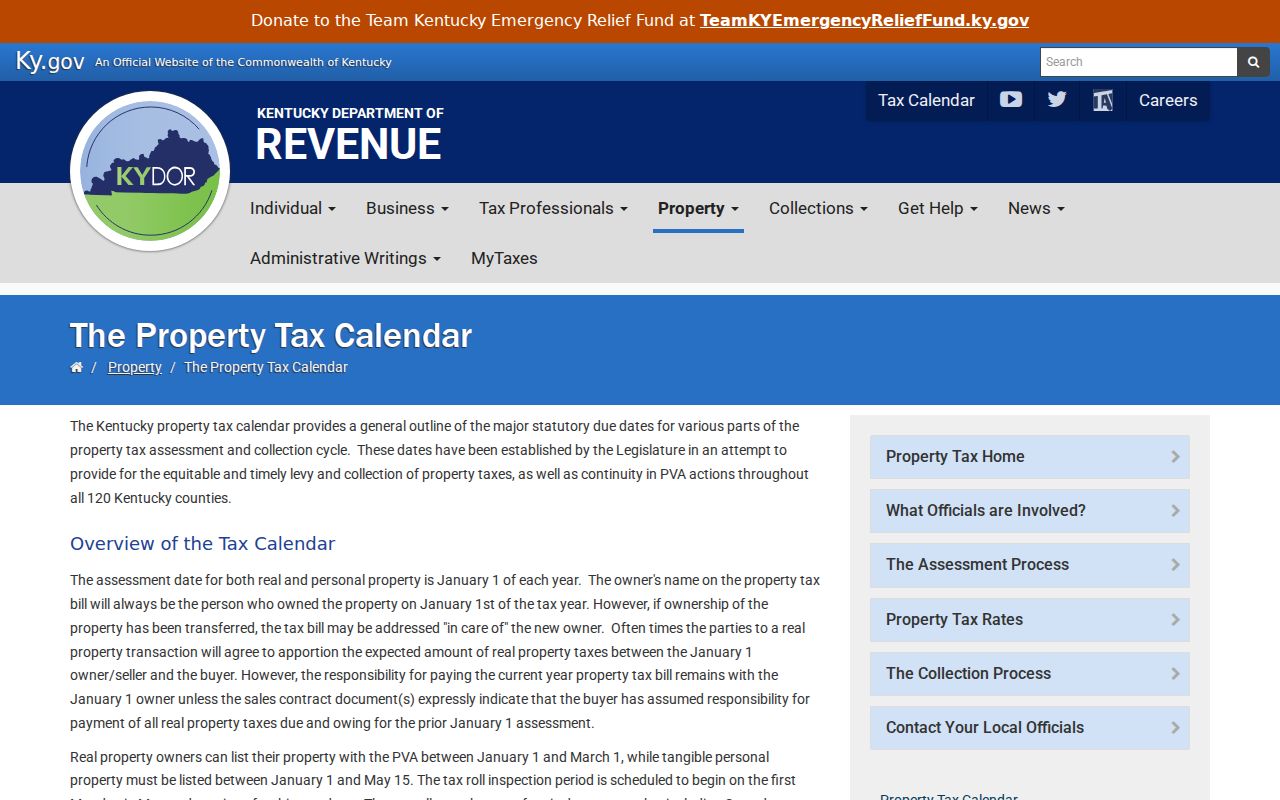
Read the current calendar together with local PVA instructions, since statewide milestones still translate into year-specific local dates in Elliott County.
Challenge an Elliott County Assessment on Time
Kentucky's property-tax calendar sets a 13-day public inspection period. It opens on the first Monday in May. That window matters. A taxpayer must first confer with the PVA. Then a written petition goes to the county board. The deadline is the next working day after inspection closes. Miss it and the appeal is gone. Strong evidence helps. It can include comparable sales, an appraisal, photographs, and repair estimates. Factual corrections to the parcel record also count. KRS 133.120 supplies the conference and appeal framework. Calendar dates move, so confirm the actual year's dates with the PVA.
Appeal window. Confer with the Elliott PVA during inspection and file the written board petition by the next working day after the 13-day period ends.